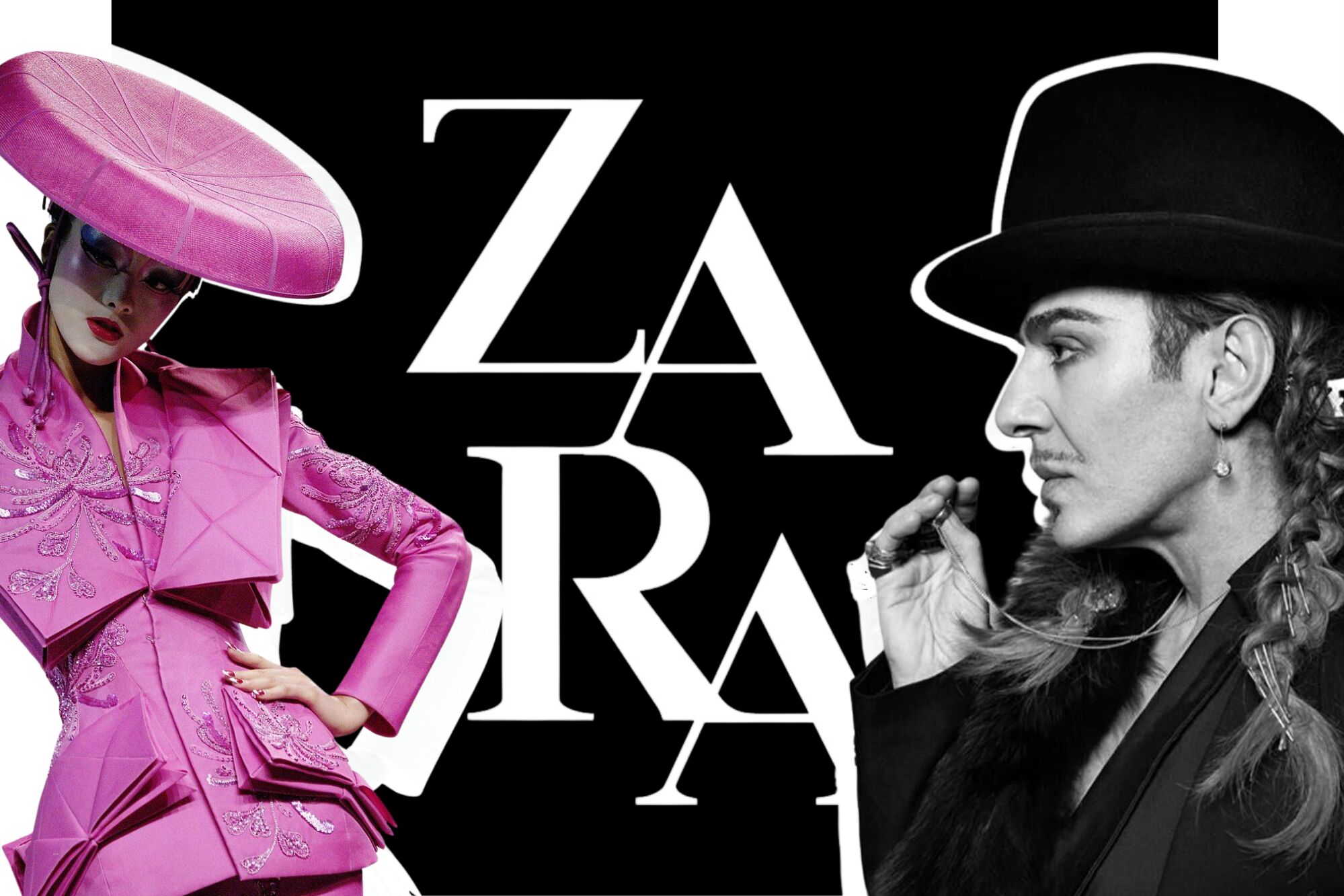

There was a time, and in the twitchy memory of the fashion circuit, it feels like an eternity ago, when the mere mention of John Galliano was enough to summon a thunderstorm. He didn’t just design clothes; he conjured hallucinations. He was the industry’s resident auteur, a man who treated the runway like a battlefield of historical ghosts, scholarly obsessions, and sheer, unadulterated theatre. From the hushed salons of Givenchy to the bombastic reign of Dior, Galliano wasn’t just a dressmaker; he was a storyteller who preferred his narratives baroque and his stakes atmospheric.

But the “Enfant Terrible” has always been a volatile currency, as influential as he was unmanageable.

Today, the name that once defined the pinnacle of French couture is tethered to Zara. To the unimaginative, this looks like a retreat: the once-great lion forced to scavenge in the plains of fast fashion. But that is a lazy reading of a much more aggressive play. Following a decade of quiet brilliance at Maison Margiela, culminating in a 2024 Artisanal collection so hauntingly beautiful it practically reset the industry’s pulse, Galliano doesn’t need a comeback. He needs a bigger boat.

Enter Inditex, and specifically Marta Ortega Pérez, the woman currently rewriting the rules of the Spanish retail giant. This isn’t a simple “capsule collection” meant to shift a few thousand polyester blazers. This is a structural infiltration.

Galliano is currently swashbuckling his way through fifty years of Zara’s archives, and he isn’t doing it for the sake of nostalgia. He has grasped a reality his peers are still too terrified to admit: in 2026, true authorship isn’t measured by the exclusivity of the silk, but by the ability to hack the machine itself. By stepping into the Inditex engine room, Galliano is proving that the “theatre” of fashion can and should exist outside the bubble of the 1%.

Why does a behemoth like Zara need a pirate like Galliano? Because the treadmill of fast fashion has hit a wall of its own making. It is too fast to be felt, too accessible to be desired. By bringing Galliano into the fold, Zara is introducing “friction”, that delicious, cultural weight that forces the consumer to slow down, even if the supply chain remains at a sprint.

It is a delicious irony. The man who once elevated fashion to the level of opera is now grappling with the ordinary: repetition, seriality, and global scale. Yet, this is where the third act of the Galliano myth unfolds. He is no longer just inventing dreamworlds for the few; he is proving that the real world, if handled with enough intelligence and narrative tension, can be just as seductive.

The Enfant Terrible hasn’t been tamed. He’s just found a louder megaphone.

C’è stato un tempo, e nella memoria nervosa del circuito della moda sembra un’eternità fa, in cui bastava pronunciare il nome di John Galliano per evocare un temporale. Non si limitava a disegnare abiti: evocava allucinazioni. Era l’autore per eccellenza del settore, un uomo che trattava la passerella come un campo di battaglia popolato da fantasmi storici, ossessioni accademiche e puro, incontrollato teatro. Dai saloni ovattati di Givenchy al regno esplosivo di Dior, Galliano non era solo uno stilista: era un narratore che prediligeva trame barocche e atmosfere cariche di tensione.

Ma l’“Enfant Terrible” è sempre stata una valuta volatile, tanto influente quanto ingestibile.

Oggi, il nome che un tempo definiva l’apice dell’alta moda francese è legato a Zara. Per gli sguardi più superficiali, questo sembra un arretramento: il leone un tempo maestoso costretto a rovistare nelle pianure del fast fashion. Ma è una lettura pigra di una mossa molto più aggressiva. Dopo un decennio di silenziosa brillantezza da Maison Margiela, culminato in una collezione Artisanal del 2024 così inquietante e sublime da ridefinire quasi il battito dell’intero settore, Galliano non ha bisogno di un ritorno. Ha bisogno di un palcoscenico più grande.

Entra in scena Inditex, e in particolare Marta Ortega Pérez, la donna che sta riscrivendo le regole del gigante spagnolo del retail. Non si tratta di una semplice “capsule collection” pensata per vendere qualche migliaio di blazer in poliestere. È un’infiltrazione strutturale.

Galliano sta attualmente saccheggiando cinquant’anni di archivi di Zara, e non lo fa per nostalgia. Ha compreso una realtà che i suoi colleghi hanno ancora paura di ammettere: nel 2026, la vera autorialità non si misura più dall’esclusività della seta, ma dalla capacità di hackerare il sistema stesso. Entrando nella sala macchine di Inditex, Galliano dimostra che il “teatro” della moda può e deve esistere anche fuori dalla bolla dell’1%.

Perché un colosso come Zara ha bisogno di un pirata come Galliano? Perché il tapis roulant del fast fashion ha sbattuto contro il muro che si è costruito da solo. È troppo veloce per essere percepito, troppo accessibile per essere desiderato. Portando Galliano al suo interno, Zara introduce “attrito”, quel peso culturale delizioso che costringe il consumatore a rallentare, anche se la catena produttiva continua a correre.

È un’ironia squisita. L’uomo che un tempo ha elevato la moda al livello dell’opera lirica ora si confronta con l’ordinario: ripetizione, serialità, scala globale. Eppure è proprio qui che si dispiega il terzo atto del mito Galliano. Non sta più inventando mondi onirici per pochi eletti; sta dimostrando che il mondo reale, se trattato con sufficiente intelligenza e tensione narrativa, può essere altrettanto seducente.

L’Enfant Terrible non è stato domato. Ha solo trovato un megafono più potente.